The Number 23
1)Institution
Name: The Number 23
Director: Joel Schumacher
Production company: Contra Films/Firm films
Distributed by: New Line Cinema
Release Date: 23rd February 2007
Country where made: USA
Budget: $30 million
Box office returns: Gross revenue was $105,036,499
Genre: Thriller, Mystery, Drama
Certificate: Rated R for violence, disturbing images, sexuality and language.
Awards: 4 nominations
Running Time: 98 minutes
2)Audience
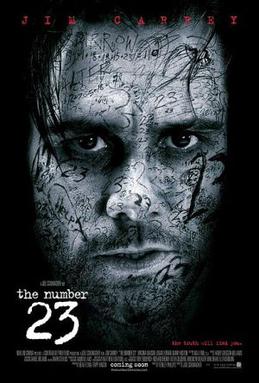
The Number 23 is a thriller film, with sub genres of mystery, drama and aspects of horror As this is quite a diverse range of genres, I would expect that the films target audience is quite vast. From looking at the films genres, I think that the target audience would mainly be fans of horror movies as from looking at the film poster and trailer, the horror aspects stand out a lot, suggesting that this film is aimed for horror lovers. The user rating of IMDB for this film is 6.2 out of 10. One user of IMDB commented: "A well written thought provoking story". Another said "A below-average, washed-up wannabe psychological horror film". The film looks like it has achieved to please the minds of the majority of the viewers with an average rating of 6.2 out of 10, however there are some people that suggested that the film had too many flaws and the plot line was lost towards the end of the film.
3) Technology
With technology ever changing and evolving with time, popularity of films have increased dramatically, mainly down to advertising. There are many ways in which the film can advertise including: banners on the internet, trailers on the tv and cinema, film posters in bus shelters and on buses, websites. As there is more technology when it comes to advertising, the general public's knowledge of the film will be increased. This may make more people come to watch the film in the cinema or purchase the dvd. New technology may have also increased audiences access of the film. For example, there are many ways in which people can watch films now days including: cinema, dvd, tv, ipod/itunes, streaming online (illegal). As there is easier access to watch films, and alternative methods to watch films, there will be an increase in accessibility.
4)Codes/forms and Conventions of the thriller genre:
The title sequence of The Number 23 consists of an off-white backdrop of paper/parchment in which a lot of numbers appear in black. The numbers show some calculations, which could put forward the theme of working things out, e.g the plot and the mystery. There are also a lot of number 23's jotted about in the screen. This could suggest that this is a main idea and recurring event, that the audience would expect to see in the film. In contrast to the black and white, there are blotches of red stains, that look like blood, that smear across the screen. The fact that the red smears look like blood could suggest that the film is quite violent and brutal, which emphasises the sub-genre of horror. The use of parchment and the text's font is as if someone is typing them up using a type writer and when the blood is introduced it could signify that the person is going threw pain to write down the information, which could later be rectified in the plot. As the title sequence goes on, there is more and more blood up to the last point where the screen is full of blood and the number "23" appears. This could represent that the person using the type writer has died and the number "23" could represent the cause of their death, creating a lot of questions for the audience. The colour red really stands out in contrast to the more neutral black and off-white. Red also connotes thoughts of danger and blood. The non-diegetic sound track is quite eerie and features a lot of drums. The use of drums makes it seem spooky, possibly representing violence because years ago, drums have been used as war drums to scare the enemy. The range of dynamics also help build up a lot of tension by having soft music followed by dramatic loud music. The sound track sounds quite electronic and the use of sound effects and phasers give the track an almost sci-fi feel to it, which again builds up tension.
There are many aspects throughout the film that genre is utilised. The main example of this is the fact that the mysterious theme is slowly unravelled throughout the film. Throughout the film, many questions arise, that later become answered. This is a typical feature of thriller and horror films and keeps the audience interested and engaged in the film. The first shot we see is an establishing, followed by a slow zoom to Walter, who is sitting in his van. The use of the establishing shot is a useful technique of setting the scene and giving the audience a quick, simple and effective understanding of the location and situation. These opening shots show Walter in his everyday life, on duty as a animal control officer, about to finish his shift, the time is shown by a point of view shot looking at the radio clock in the van. A few minutes until he has finished his shift, he receives a call in from a women secretary who has a grudge on him after a Christmas work do. We then see a flashback, represented by rewinding very quickly. Flashbacks are typical conventions of thriller films and they act as a explanation of occurring events. A scene with his family at home shows summarises his life and shows the audience that he has a good, enjoyable life and gets on with his wife and son. This could act as a contrasting device as towards the end of the film, him and his family become more corrupted. The next scene, Walter is attempting to capture a vicious bull dog. An interesting shot used in this scene is the point of view shot of the dog behind the cage. The camera moving out from behind the cage signifies the movement of the dog as he confronts Walter. Walter gets bitten by the dog after failing to capture him and has a serious, deep wound to his arm. This could act as foreshadowing of events to come as blood is involved and Walter is very stressful. Another convention of thriller films present in the film is the use of fast paced editing when a action scene is involved. Fast paced editing makes the audience feel as they are in the situation as it is real time and everything is happening so quickly. It also helps show perspectives of other characters to give the audience a fuller understanding. Fast paced editing in action scenes also contrasts with slow, calmer cuts and editing in other parts of the film, which gives variation to the film and makes the action scenes seem more excitable.
Isolation is a key theme in this film and a typical convention of thriller films demonstrated by uses of long shots and the main character, Walter on his own a lot of the time. Walter, who plays the main character, gradually becomes more and more isolated as his mind becomes possessed. The isolation creates thoughts of being vulnerable and the audience may develop a fear of the character because as he becomes more isolated he becomes more Infatuated. Another convention of thriller films utilised in The Number 23 is the use of foreshadowing through means of the mysterious book. Foreshadowing is a device used that give hints and clues about things that become developed in more depth as the film unravels. There is also cases of red herrings when it comes to discovering what the actual number "23" is all about. The use of red herrings is to send the audience in the wrong direction so that there is a twist in final scenes of the film. This makes the ending a lot more effective and is a typical feature in thriller films and mystery films/TV programs. For example murder TV programs such as midsummer murders often use red herrings in a way that makes the audience believe that one character is the murderer, but in actual fact, later on in the program the audience discover that it is actually someone else who was less expected that was the murderer. It is a very effective way to end a film/TV program as it makes the audience think and possibly leaves them in awe.
Mise en scene
Saturday, 5 December 2009
Case Study - The number 23
Meeting 2
Meeting 2
For the second meeting we discussed the storyline and the people to the play the characters.
Plot: Sun almost setting over the isolated scene - another isolated scene in Norfolk in the distance you can see a car with the bonnet open and a man standing over it, the sound of the engine starts and then dies. The camera moves closer to the car so that you can see the female in the car. The shot changes to a mid shot of the back of the man looking at the engine he then closes the bonnet and sighs. The couple than start to have an argument about how they are lost and the car is broken down, throughout this there will be a switching of over the shoulder shots, and also some shot that show they are in a fight i.e only showing one of them, I got this idea from the film Vacancy. After the fight the girl walks of saying “I’m going to try and get signal” in a bad attitude. There will be some selection of shots showing her walking and getting signal. While she is doing that the boyfriend gets out the car and moves around, their will a shot of the field and a shape move in front of the camera, giving the sense of someone being there. It will then show a shot of the reflection in the window of the car, showing the boyfriend being stabbed. The women walks back looking at her phone saying I cant get signal “anywhere.” After realising that her boyfriend isn’t at the car she looks about and shouts a his name, she starts to looking in the car and sees a note, it reads I have found a town down the road meet me their. As she is walking down to the town there is a shot where the camera is in a hedge you see a hand with blood dripping down it and in the background the women walks past it not seeing it. It will then end with the sun setting fully.
Though the opening there will be parts that have mysterious and spooky music to go with the conventions of a thriller
For the blood we are going to use watered down ketchup, with a little HP source to make it less red. If this turns out a bit too tacky and looks unprofessional we will use fake blood instead.
Characters:
Killer - Jack Rolph
Women (yet to be named) - Harriet Millsopp
Man (yet to be named) - Will Durham
Meeting 1
Meeting 1
For our first preproduction meeting, on making an opening to a thriller, we decided to talk about any ideas that we had, and this is what we came up with:
Richard put forward an idea that he had been thinking about it was to film a sunset over a flat rural area, this would be to show the isolation of the area.
Another idea that we had was maybe filming some people moving in a city and then to speed it up. Also to have a person moving though the people, very slowly though so that he can stand out, this would be to show the persons abandonment from the world. I came up with the idea of having the sound of a heart beat matching his footsteps as this would help build up tension.
After a few ideas we decided to make the genre thriller and horror, we believed that this would be the most suitable genre for our film as most of the ideas that we came up with where for the conventions of a horror and thriller. We then came up with more ideas for this:
We had an idea that maybe a character had visions of an arm with blood dripping down.
For the plot of the film we thought maybe of a modern jack the ripper story.
For the location we thought maybe isolated area in Norfolk or maybe in a multi story car park.
We thought that the maybe the first person that the killer kills might be a hitchhiker.
We then thought of a person who has a broken down car in the middle on nowhere.
We also thought of putting in a twist at the beginning. We thought of a person that we would make out to be the main character in the beginning and then later would turn out to be the victim of the killer.
The killer may have a signature to his crime i.e symbol, weapon of choice.
Monday, 23 November 2009
Saturday, 14 November 2009
Ratatouille and Flushed Away

Flushed Away is a computer animated British film that was released in December 2006. It was directed by David Bowers and Sam Fell. The film had a partneship between Aardman Animations and Dreamworks Animation. It was distributed by Paramount Pictures in cinemas. Flushed away was released on dvd in the UK on the 2nd of April 2007. The box office perfomance collected $64,488,856 in the United States, which was below the average of other CGI films from Dreamworks Animation, but a healthy $111,814,663 from international markets for a worldwide total of $176,319,242. Flushed Away was Nominated for BAFTA Film Award. It also gained another 6 wins and 10 nominations. The certificate of the film is PG as it contains some crude humour and mild language. The plot summary is as follows “The story of an uptown rat that gets flushed down the toilet from his penthouse apartment, ending in the sewers of London, where he has to learn a whole new and different way of life.”
Ratatouille is a 2007 computer-animated film produced by Pixar and distributed by Walt Disney Pictures. The film was the eighth movie produced by Pixar, and was directed by Brad Bird, who took over from Jan Pinkava in 2005. The title refers to a French dish which is served late in the film, and is also a play on words on the species of the main character. In its domestic opening weekend, Ratatouille opened in 3,940 theaters and debuted at #1 with $47 million, the lowest Pixar opening since A Bug's Life. However, in France, where the film is set, the film broke the record for the biggest debut for an animated film. In the UK, the film debuted at #1 with sales over £4million. As of January 13, 2008 the film has grossed $206,445,654 in North America and a total of $624,445,654 worldwide, making it the third highest grossing Pixar film of all time, just behind Finding Nemo and The Incredibles. The film Won an Oscar and had another 43 wins & 20 nominations.
Both of the films share similar assets. For example, both films use computer-generate imagery (CGI). Both films use animorphism, which is where animals act like humans and can speak. The use of animorphism is a typical convention of animation/feature films and particularly pleases a younger audience. Both films have also released merchandise, making the film even more successful in terms of advertising and revenue.
Cutting It
Cutting It follows the traumatic life of hairdresser Allie Henshall, alongside her lovers, her rivals and her dysfunctional family. Allie Henshall and Gavin Ferraday run a successful hairdressing salon called Henshall Ferraday. Their plans to expand the business are dashed when a rival company called Blade Runner opens a salon right across the road from their premises. Blade Runner is owned by Mia and her husband Finn, and to complicate matters Finn used to be the love of Allie's life. It was a popular BBC television programme set in Manchester, England, which ran for four series between 2002 and 2005.
Friday, 6 November 2009
Production Tips
Diegesis.
Sound in movies play an important role in creating meaning and understanding for the audience. Sound comes across in two forms; diegetic sound, and non-diegetic sound.
Diegetic sound is sound that is present in the scene and where characters are aware of it. Diegetic sound is any sound presented from a source within the film's world. Examples of non- diegetic sound include dialogue, sound effects which are heard by characters, (for example gun shots, thunder, or explosions) background music which is heard by characters (for example the radio or CD players).
Non- diegetic sound is sound that is only there for the audiences viewing experience. It is added in after the shooting and can come in forms or soundtracks, atmospheric music, voice-overs or narration. Non-diegetic sound is sound that source
Is neither visible on the screen nor has been implied to be present in the action.
Some types of sound are both diegetic and non-diegetic. An example of that is a characters voice-over. It is diegetic because the character is aware of the sound, as he/she are saying creating it. It is non-diegetic because other characters will not hear it.
Micro and macro origination
When aiming a film at a target audience, you need to take into account the micro-macro strategy. This will enable you to include conventions of a particular genre or style of film. The microelements would include types of camera angles, music, style of titles, dialogue, setting and pace of the film. All of these elements will add up to a macro theme and set of representations that will help you accomplish a particular genre of your film. For this reason, pre-production tasks are very important so you can develop your ideas and make sure that your approach to filming is not out of step with the conventions of the type of film you are making.
Camera work and framing
In order to obtain a steady shot whilst shooting a film, it is best to use a tripod to maintain a smooth shot. If you are aiming to create an effect of a realist/documentary shot then a handheld camera would work well. Most shots are still shots. This allows the audience to pick up any movement that happens in the scene, whether it being by characters or objects. This allows movement to become an effective exception to the norm. Zooming is rarely used in films as it can come across quite amateur, so unless you are trying to capture the amateur effect, it is best to avoid zooms.
Film uses fewer close ups than TV. This is mainly because the viewing screen in film is a lot bigger. When you are filming, you should make sure to select a wide screen framing. With film, it is recommended to use mainly mid-shots and long shots, with close ups used sparingly.
The rule of thirds is a concept in video and film production in which the frame is divided into nine imaginary sections. It is best to avoid the central square when it comes to positioning objects, as the eye is drawn to off-centre areas. Putting people and objects off-centre will focus the audience’s concentration on the image.
Using a range of shots is essential to the film. Combining a range of shots enable you to capture action, emphasise location and put you in the characters perspective. These shots will allow the audience to get a better understanding of the film and the range of shots will make it a more interesting viewing experience.
Camera angles can give off impressions and connotations of characters. For example a low angle shot would connote that the particular character is big and powerful. A high angle shot would make a character seem small and defenceless. Simple techniques like these give the audience an understanding of the character.
Other tips that will help make your film seem more professional include: make sure that you practice the type of shot you about to take a few times before actually recording. This will make the shot seem of better quality, as you will have learnt how to capture the shot effectively and professionally. Test microphones are working correctly before you start recording so you don’t end up with a silent movie by mistake. Be a perfectionist and re-film a shot if the camera accidentally shakes, or if you are not pleased with the shot you have taken. Try out different camera shots so that you can include a range of different camera shots in your film.
Mise en scéne
Mise en scéne is an expression used in theatre and film to describe the design aspects of a production. It is all about the atmosphere and continuity of the film and essentially is all about detail. Try and choose the correct props, costumes, lighting and locations to create the right kind of vibe you are trying to create in your film. Try to make your mise en scéne consistent. This will make your film flow more and seem more professional. Try to avoid silly mistakes such as costume changes mid sequence as this will make the film seem very unprofessional. Poorly chosen props, along with bad acting will make your film seem very unprofessional and you should try and choose actors and actresses that also take drama so that they are more comfortable.
Lighting
Here are five tips copied from Michael Massey article for Media Magazine about how students can make use of lighting without the use of expensive and professional lights.
1) Use natural light- sunlight, in shadow, in mist, through rain- depending on the effect you need, and bearing in mind that you will have to be flexible about time if you need to wait for the right conditions.
2) Use cheap and cheerful artificial light- as long as you have carried out the risk assessments, you can make use of candles, firelight, torches, car headlights, security lights, neon signs and street lighting.
3) Create colour filters- you can easily shine light through coloured liquids, vases, ornaments.
4) Position the light source for effect- lighting a scene from above, below or in an obscured way will create different kinds of atmosphere (mise en scene), so experiment with this using the kinds of light source listed above.
The grammar of non-linear editing
You will need to observe the rules of grammar that apply when it comes to editing and creating continuity in your film. You also need to choose the right rhythm and pace of the editing. Using effective transitions between clips will make your film seem proffesional and help make your film slow. You should try to use hard cuts for 90 per cent of your editing, this is a simple, but effective editing technique.
Combining sound, image and titles.
When it comes to putting together footage with suitable sounds and titles you need to make very careful decisions. You need to choose items that are suitable for you films genre. Try and choose fonts that are appropriate for you films genre, such as gothic, scary font for a horror film. You should use trial and error when it comes to choosing the best font. Choose a reasonable time for the titles to appear on screen, you don’t want it to be on there for too long, but also you don’t want it to whiz past not allowing the audience enough time to read it. You also need to take into account what effect the titles have on the audience’s understanding of the narrative, genre and representational aspects that you need them to grasp quickly since this is an opening sequence.
You should choose music to add ambience to the start of your film that helps build a lot of tension. You should think about the semiotic function of the music and make sure the music is the same pace and tone of the sequence.

 Posts

